
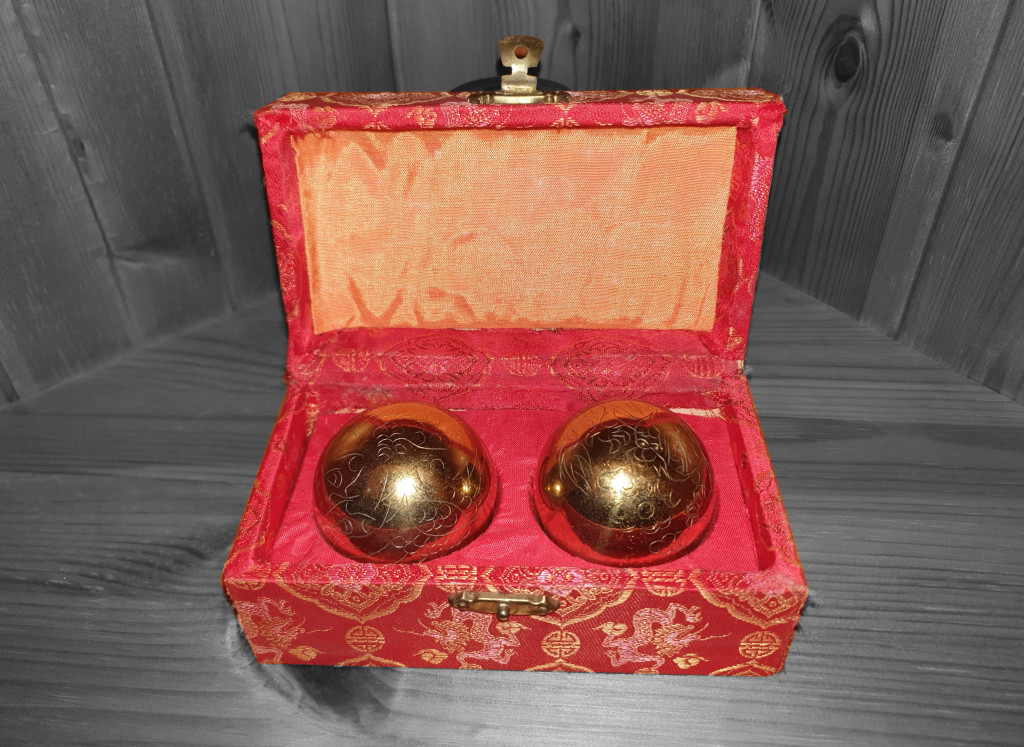
I find myself inexplicably drawn to the little chest sandwiched between a battered copy of Treasure Island and a hard cover edition of a Chambers Dictionary of Etymology, its paper wrapping long ago discarded. Pens and pencils rattling, I remove the art deco stationery holder that has been rudely balanced on top of it. Running my fingers along the dusty lid before lifting it from the shelf, I place the chest gingerly on the table, the contents within singing gently. It is heavier, much heavier than anticipated, given its modest size. Blood red satin with a gold oriental pattern evocative of damask has been lovingly wrapped around the chest. The words ‘HEALTHY BALL’ scream out from a matching label smoothed over the centre of the lid, jarring against the serenity that radiates from the otherwise luxuriously decorated box. ‘Lotus Pond’ is the only other English; the rest of the label is comprised of Chinese symbols painted in a black spidery hand, now spotted with damp. Thinking vaguely of ancient stone temples, I pop the ornate bronze fastening and ease open the lid.
The smell hits me first; it is musty and old, much like the decrepit books one finds stuffed in the back of a grandparent’s house, forlorn and forgotten. In the time it takes to blink, the table and the little red chest in front of me disappear and I am back in my grandad’s cluttered living room after his funeral, walls lined with a multitude of tomes, each vying with its neighbour to be chosen and loved once more. A person’s wealth, grandad used to tell me sagely whilst puffing on his pipe, is measured not by his financial status but by his breadth of knowledge. If this is the case, my grandad was extraordinarily rich; his personal library, much of which I now own, was extensive.
There is a second scent however, that accompanies the mustiness and it is this that pulls me back to the present. Delicate and floral, it hovers just outside my grasp; the more I try to hold onto it the more it dances away from identification. All thoughts of temples now swept away, my attention returns to the contents of the box. Nestled in satin lined grooves are two brass Baoding balls. Also known, rather unimaginatively, as ‘hand exercise balls’ in the Western world, these little orbs are believed to originate from the Ming Dynasty. Said to improve dexterity, support meditation, aid body building and promote good health simply by rolling them in one’s hand, the technique for making them is a secret passed between generations for hundreds of years.
They peer up at me, their smooth surfaces mute and unyielding in the afternoon light. Like the books in my Grandad’s house, the orbs need a human’s touch to breathe life back into them. Feeling intrusive in the face of all the secrecy associated with these medicine balls, I pick one up. Despite resting with its counterpart in lashings of satin, the Baoding ball is ice cold. It rings in my hand, vibrating slightly as I turn it over. The sound is reminiscent of a church bell, melodic and full bodied as it interrupts the hushed stillness that has settled around me. The back of my neck prickles and for a second, I feel as though I am in a place of worship. Lotus flower tea, I think suddenly; that’s the smell.
Feeling something catch beneath my fingertips, I raise the ball up to the light. To my surprise, there is an etching of a Chinese dragon carved into the surface. It is truly intricate work; the dragon, surrounded by curls of flame, is portrayed with its mouth pulled back in an infinite roar, the scales on its body glinting while its tail wraps around itself protectively. It is not a ferocious depiction however; the dragon is friendly rather than threatening. I lift the other orb from the safety of the chest and it too has a dragon etched on its otherwise smooth surface. This one however, is distinctly feminine, its features delicate and significantly less detailed. Male and female, I realise. Rolling them around in my hands, I notice that they sound different, too. The female orb is deeper, less melodious than the male. Clanging together in a not entirely unpleasant manner, I suspect that, in experienced hands, these Baoding balls will sing beatifically.
 Lydia Ruth